Tired of the daily grind? Imagine standing under the northern lights in Iceland or watching hot air balloons drift across the sky in Cappadocia, all without leaving your living room. Brink Traveler is the ultimate VR travel app for Meta Quest, offering incredibly realistic, 3D-scanned environments of the world’s most breathtaking natural wonders. In this deep dive, we explore its stunning day and night modes, the interactive AI guide, and multiplayer features. Discover why this app is an absolute must-have, and learn how to use our exclusive VRPUPU promo code to grab a 10% discount on your next virtual getaway.
What does it actually feel like to travel inside VR?
…Work really does wear you down, day after day.
If I could take a long break, I’d want to see just how beautiful this world really is with my own eyes.
If there were no burdens at all, I’d go to Háifoss in Iceland.
During the day, I’d just stand there, watching the water fall from the sky without a single thought.
And when night comes, I’d look up—
and lose myself under a sky filled with stars.

I think back to those days.
When I was a junior in college, I rode my motorcycle up into the mountains wearing a rain poncho, shivering in the cold, just to watch the Leonid meteor shower.
…Man, I really was young back then.

Now, all I can really do is remember.
I don’t have the nerve anymore to take real time off and head out on a long journey.
You’re probably the same.
Maybe the only time we’ll truly travel again is the year we retire.
The stars will still be just as beautiful, I’m sure.
But by then… will we still be able to climb the mountains?
There’s one thing I do know.
I put on my Meta Quest headset, launch Brink Traveler, and close the door.
—That’s departure.
The scenery inside VR is almost indistinguishable from reality.
Iceland is… truly beautiful.
So let’s see where this app will take us next.
So… where will Brink Traveler take us?
The destinations in this app keep growing, little by little.
As of January 2026, there are already 34 locations you can travel to.
Many of them feel almost unreal, like something out of a dream.
And about half of them are places we’d never see with our own eyes, even in a lifetime.
You’ve seen National Geographic before, right?
That harsh yet majestic landscape of the American West.
The Grand Canyon, Arches, The Wave, Death Valley, Red Rock, Lone Pine Peak…
They say the air out there is so dry it can take your breath away.
Iceland is completely different.
The colorful valleys of Landmannalaugar, the towering cliffs of Háifoss.
Places where, if the wind hits you the wrong way, you honestly feel like you can’t even stand.
The Cirque de Gavarnie in France, the Dolomites in Italy,
Preikestolen in Norway, Cappadocia in Turkey.
Every name sounds like a magical land pulled straight from a storybook.
And yet all we have to do—
is reach out our hand, and step into that world.

In Brink Traveler, all it takes is a small swipe to the left or right to choose where you want to go tonight.

Each location comes with a short description covering its history and scenery.
Tap Download, and it installs directly onto your headset in Brink Traveler

After waiting a minute or two for the download to finish, press Travel.
—And you’re off.

Right now, there are 32 countries and locations you can visit in total.
Honestly, I don’t really know how this company makes money.
Most VR studios push out tons of paid DLC after launch, one pack after another.
But this one just keeps adding new destinations—for free—even after release.
It almost feels like they’re saying this:
Let’s stop talking about money.
The Earth is beautiful.
Let’s take a little more time to really look at it.
Alright—let’s take a look. Just how beautiful this planet really is.
Last night, I took a short trip in Brink Traveler.
Cappadocia in Turkey. Háifoss and Landmannalaugar in Iceland.
And Arches and Lone Pine Peak in the United States.
Cappadocia, Turkey.
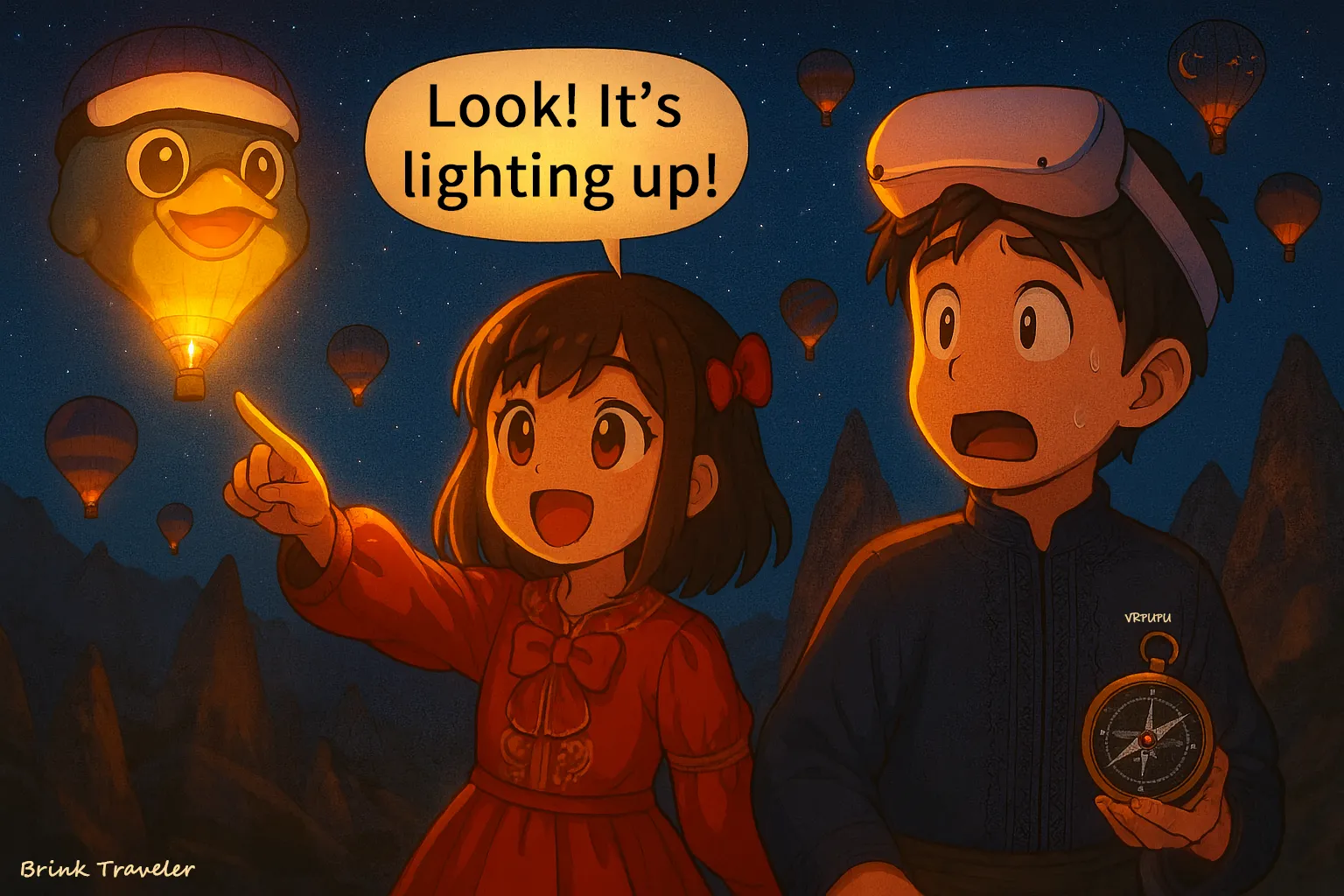
A land where countless hot air balloons drift across the sky.
Open any Turkey travel guide, and Cappadocia is almost always there—one of those classic destinations everyone talks about.

Colorful balloons rise slowly into the sky.
Wrapped in that glow, you can’t help but feel it—
Turkey somehow feels warm, lively, full of energy.

In the distance, birds glide alongside the balloons.
Sunlight spills across the plains, and the world begins to shine, little by little.
Watching from above, maybe the birds are wondering—
How can these people fly… without wings?

Against the star-filled sky, one patch suddenly goes dark.
And then you realize—it’s a hot air balloon, drifting slowly across the night.

I didn’t know this until yesterday.
Hot air balloons make that deep “whoosh” sound every five or ten seconds.
And in that brief moment, the entire sky lights up.

Háifoss, Iceland.
They say Iceland is bitterly cold.
So I turned the air conditioner down a notch.
…Atmosphere matters, right?
That way, it feels just a little more like you’re really there.

Water pours down from the sky.
Slowly—truly, painfully slowly.
It feels as if time itself is being pulled into that flow, moving at the same unhurried pace.
The sky looked alive.
Four birds rode the wind, circling overhead.
Through gaps in the heavy clouds, a soft orange light slowly seeped through.

When night fell, there was almost no sound at all.
Above my head, only the Milky Way hung there in silence.
And in that moment, a memory surfaced.
Me, long ago—back when I was still a student.
I was looking up the same way then, staring at the very same stars.
Landmannalaugar, Iceland.
Why did I pick two spots in Iceland?
Because—this is where the aurora is.
I’ve never seen the northern lights in real life.
Do you know what they actually look like?

This is volcanic land.
The ground is scarred with countless streaks of hardened lava.
Looking down from the mountain peak toward the valley below,
the distance alone makes you think—
if you had to climb this on foot, it would be brutal.
But in VR, none of that matters.
I just stood there, and looked up at the sky.

See?
The aurora glows a bluish green,
like a vast curtain of light swaying in the wind,
slowly, quietly sliding across the night sky.
…Starting tomorrow, I can say it too.
That I’ve seen the northern lights.

Arches, United States.
I’ve never been to America.
But I’ve seen America plenty of times—through movies.
This landscape feels strangely familiar.
In Mission: Impossible 2, Tom Cruise kept climbing this place over and over again.

It’s vast here—and utterly rugged.
When the wind passes through, all that’s left is the sound of sand.
If you look closely, there’s a single bird perched at the top of the arch.

Looking out into the distance, the ground is nothing but rock in every direction.
And in that moment, a thought crossed my mind.
That place where Goku and Vegeta used to fight—
yeah, this is it.

When night falls, the shape of the arch stands out even more clearly.
The stars are probably the same ones in the sky,
but seeing them here—in America—feels completely different from Iceland.

When I was in elementary school, I was obsessed with Zodiac — Saint Seiya.
I bought a little constellation chart from a stationery shop
and used to point it at the night sky, searching for Pegasus.
Apparently, you can still buy those star charts today.
But—under city skies now,
there are hardly any stars left to see.

Lone Pine Peak, United States.
This isn’t a place meant for sightseeing.
No matter how much money you throw at it, there’s no guide who’ll casually take you up here.
—This is a world that belongs to climbers.

From the summit, looking down,
both the land below and the ice-bound mountain ranges felt astonishingly quiet.
Up here, the world stood alone—
utterly still, wrapped in silence.

You know something?
Right now, I’m standing on a huge rock at the summit of Lone Pine Peak.
If this weren’t VR—
there’s no way I’d be standing here.

There are places on this planet you can’t reach—no matter how much money you have.
But in VR—
that’s enough. Let’s go.
If you want to travel the world without leaving home, just take a look at Brink Traveler on the Meta Store.
And when you buy a headset from Meta’s official site, enter VRPUPU at checkout—you’ll get an extra $30 in Quest Cash.
On top of that, for games that aren’t already discounted (and even some DLCs and bundles), entering VRPUPU at checkout knocks another 10% off right away.
Now that we’ve felt the journey, let’s look at the tools that make it possible.
How to Use Brink Traveler
Up to now, we’ve been talking about the feeling of traveling. From here on, let’s get into how it actually works.
First, grab Brink Traveler from the Meta Store.
Once you’re in a journey, raising your left hand or right hand each has its own role—and they’re both used more often than you’d expect.
Left Hand: Watch Functions
Look at your left hand and you’ll see the watch on your wrist—you use this to control it.
From here, you can open Settings, switch to the Social screen, and toggle Voice Chat on or off.
You can also switch between day and night from this menu.
At the top of the screen, you’ll see the current temperature and wind speed for your location.

Settings Menu
This is where you fine-tune movement, language, and overall comfort to match how you play.
If this is your first time, it’s worth taking a minute to skim through these options before you start.
- Comfort Settings
- Movement: These control how you move around, and they have a big impact on motion sickness.
- Seated Mode: On / Off (whether you play seated or standing)
- Mode: Smooth / Step / Snap (Smooth is recommended—it feels closest to walking)
- Speed: Slow / Normal / Fast (Normal feels the most natural)
- Direction: Head / Hand (Head-based movement is recommended for smoother control)
- Acceleration: On / Off (Default settings are fine for most people)
- Terrain Follow: Follow / Flat (Follow is recommended; Flat makes you feel like you’re floating)
- Turning – These affect how your view rotates.
- Mode: Smooth / Step / Snap (Smooth can cause motion sickness for some people)
- Speed: Slow / Normal / Fast
- Movement: These control how you move around, and they have a big impact on motion sickness.
- Experience Settings
- Environment: Options related to how system UI and visuals appear.
- Language: Choose from English, Japanese, Traditional Chinese, and more
- Virtual Guide: On / Off (On is recommended—the explanations are much clearer)
- Subtitles: On / Off
- Boundary Overlay: On / Off (Shows a red line at the edge of the playable area)
- Haptics (Vibration): On / Off (On is recommended—it adds nice tactile feedback)
- Audio Settings
- Music: On / Off (On is recommended)
- Environment: On / Off (On is recommended)
- Environment: Options related to how system UI and visuals appear.
- Use Default Settings: Resets the app to its default state.
- When you see “Reset settings?”, confirming will return everything to the original configuration.

The red boundary line looks like this.
It marks the limit—you can’t go past this point.

There are also extra functions on the left and right sides of the settings screen.
On the right side, you’ll find the control tutorial.
This is where you can check how to use the radio, how to take photos, and other basic interactions.

On the left side, you’ll see an introduction to the development team.
There are seven developers—and one dog as part of the crew.
Your own photo also appears at the bottom, reminding you that everyone here is part of the same journey.

Social Screen
This is where you can invite friends and travel together.
- Public: A mode where you journey alongside players from around the world.
- Private: A mode where only your friends can join you on the trip.

You can travel with up to five people at once.
Everyone is free to explore on their own, or you can walk through the scenery together as a group.
You can also see which spot each friend is currently visiting in the list.
Tap the eye icon under a name to toggle whether your avatar is visible at that location.

Right Hand: Tool Functions
With your right hand, you can use tools like the radio and the compass.

Walkie-Talkie
Pick up the radio and press the trigger, and you can talk directly with the AI guide.
I tried it in a few different languages—
- English: Real conversations. Responses are smooth and make sense.
- Japanese: You’ll get replies, but sometimes they’re a bit off.
- Chinese: I tried it, but didn’t get any response.

For example, if you ask in English, “Is that a lake?”
you’ll get a proper reply like,
“There are several geothermal areas and dramatic landforms around here, but there aren’t any well-known lakes in this area.”
…That’s the level it answers at—clear, natural, and actually useful.

Compass
This tool helps you find the three points of interest in each location.
Turn your body and line yourself up with the “?” markers shown on the compass.

When you line yourself up with the marker, that spot gets unlocked.

Once it’s unlocked, the guide will give you a detailed explanation of that spot—its background, history, and the story behind it.

Each location has three different spots, and you’re free to explore them in any order.

Photo Mode
The instructions say, “Strike a pose to activate the camera,”
but no matter how many times I tried, nothing happened.
After messing around a bit, I figured it out—
you can also bring up the camera with this gesture instead.
When you’re ready to take a shot, press the round button in the center to trigger the shutter.

When you take a selfie, there’s a three-second countdown.
That’s your moment—strike a pose before the shot goes off.

When you’re shooting scenery, the shutter fires instantly the moment you press the button.

Every photo you take is automatically saved to your album.
That way, each moment of your journey is properly recorded and kept.

Places You Can Visit in Brink Traveler
As of January 2026, there are 34 locations available in total.
Here’s the full list.
| Country | Number of Places | Main Locations |
| United States | 18 | Mount Morrison, Glen Canyon, Crystal Crag, Arches National Park, Horseshoe Bend, Lake Tahoe, The Wave, Mount Whitney, Lone Pine Peak, Antelope Canyon, White Pocket, Death Valley National Park, Bryce Canyon National Park, Red Rock Canyon, Alabama Hills, Goblin Valley, Singing Canyon, Sequoia National Park |
| France | 4 | Cirque de Gavarnie, Réunion Island, Dune of Pilat, Marseille |
| Iceland | 3 | Landmannalaugar, Háifoss Waterfall, Vatnajökull |
| New Zealand | 2 | Aoraki, Sunday Mountain |
| Spain | 2 | Peña Escoda, Bardenas Reales |
| Greece | 1 | Navagio (Zakynthos Island) |
| Norway | 1 | Preikestolen |
| Italy | 1 | Dolomites |
| South Korea | 1 | Ulsanbawi Rock |
| Turkey | 1 | Cappadocia |
That’s the complete usage guide for Brink Traveler.
If the kind of trip you’re looking for is a guided tour with others,
or walking through city streets,
or even standing once more in the schoolyard of your childhood—
then take a look at the next article.
That’s where I’ll go into detail about how to take those kinds of journeys.
Best VR Travel Apps on Meta Quest
Brink Traveler, Wander & More
Wander VR App Guide
Multiplayer Google Street View on Meta Quest
FAQ – Common Questions
Is Brink Traveler a paid app?
Yes, the base app is paid. That said, the development team keeps adding new locations through free updates, so there’s no need to buy any DLC.
What languages are supported?
Right now, it supports nine languages: Japanese, Traditional Chinese, Simplified Chinese, German, French, Italian, English, Spanish, and Korean.
You can also switch the guide’s voice language. Just pick the one you’re most comfortable with.
Is it likely to cause motion sickness?
You can fine-tune things like movement style, turning mode, and speed.
The least nauseating setup for most people is smooth movement combined with step turning.
Does it support multiplayer?
Yes. You can travel with up to five people at once, and choose between Public mode and Private mode.
Are photos saved automatically?
Yes. Every photo you take is automatically saved to your album, so you can revisit your journey anytime in Brink Traveler.